
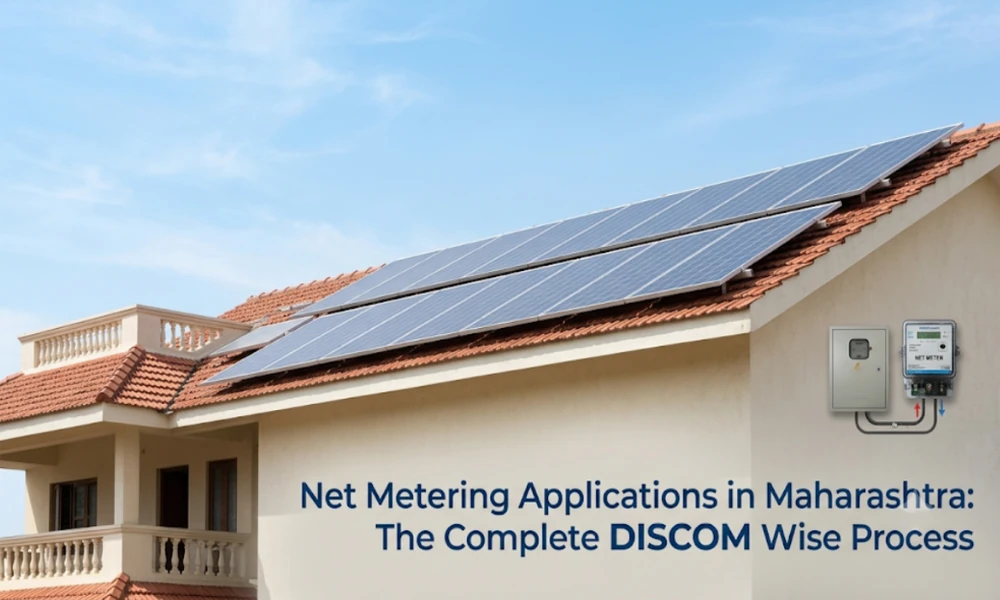

If you’ve installed rooftop solar panels in Maharashtra, net metering is what actually makes the investment pay off faster. In simple terms, it lets you send surplus solar power back to the grid and get credited for it on your electricity bill, reducing your overall costs month after month. The Maharashtra Electricity Regulatory Commission, or MERC, has laid out clear rules around this process, and once you understand how it works, applying becomes fairly straightforward rather than the confusing maze it might seem at first.
Where Maharashtra Stands Today
The state of Maharashtra is one of the highest consumers of electricity in India, along with other cities like Mumbai, Pune, Nagpur, and Nashik. Rooftop solar adoption is high in this state, with over 3 lakh people having adopted rooftop systems till 2025.
What differentiates the system of Maharashtra from other states is that it has six different DISCOMS including MSEDCL, Adani Electricity, Tata Power, Torrent Power, BEST, and MSETCL, which process their net metering applications, portals, and timelines for processing independently. The DISCOM to which you are associated will depend on your location and your connection and not the city that you reside in. Many people who reside in Mumbai have the misconception that they are associated with MSEDCL but the actual DISCOM they are associated with is either Adani Electricity or Tata Power.
According to the MERC guidelines, all DISCOMs are obligated to approve the net metering application for residential systems up to 10 kW, and technically valid applications can never be rejected. Settling occurs on a monthly basis, which means any extra energy you generate will be settled against the amount of energy you consume during the same month, and remaining energy will roll over to the next month’s bill. After installation of the system, DISCOMs are obliged to install your bi-directional meter within 30 days for systems up to 10 kW, and 60 days for bigger systems.
Step by Step Application Process
- Identify your DISCOM. This is clearly mentioned on your electricity bill, so check it before you begin, since your DISCOM depends on your connection, not just your city.
- Register on the portal. Most applications now go through the national PM Surya Ghar portal alongside your specific DISCOM’s own portal. You’ll need your consumer number, mobile number, and email ID to get started.
- Fill out the Rooftop Solar Application Form. Log in and submit accurate details about your proposed system, including capacity and installation address.
- Wait for feasibility approval. Once your DISCOM approves feasibility, you can move ahead with installation. Choose any vendor registered specifically with your DISCOM, since approvals aren’t uniform across all six.
- Complete the installation. Once your chosen vendor finishes the installation, submit your plant details through the portal.
- Apply for the net meter. After submitting plant details, put in your application for the net meter itself.
- Get your system inspected. Your DISCOM inspects the installation and installs the bi-directional meter.
- Receive your commissioning certificate. This gets issued through the portal once the inspection and meter installation are complete.
- Submit your bank details. This finalises the process, and any applicable subsidy gets credited directly to your account.
Documents You’ll Need
If you own the solar system outright, you’ll need to submit technical details of your generating system, inverter, and associated equipment. For partnership firms, a general power of attorney in favour of the signatory is required. If the system is leased through a third party rather than owned directly, a mandatory leasing agreement needs to be submitted alongside the other documents. For systems 200 kW or larger, Electrical Inspector permission becomes mandatory as well, on top of the usual paperwork.
A Few Things to Keep in Mind
Make sure that you have the correct consumer number, as submitting your application with incorrect information will lead to your application being routed to an incorrect field office. Always keep a record of your request ID for easy tracking. It should be mentioned here that the application processing fee is non-refundable once you submit it, and thus it makes sense to be prepared beforehand. In addition to the subsidy amount that you might get, you will also have to pay for the net meter, generation meter, and overall installation costs.
Getting Support Along the Way
Whether you’re in Mumbai navigating a multi-DISCOM landscape, or in Pune and Nashik where the process tends to be a bit more straightforward through MSEDCL, having a reliable partner for your rooftop solar panels makes the entire journey smoother from start to finish.
Waaree, India’s largest solar panel manufacturer with over 25.8 GW in manufacturing capacity, offers a wide range of solar solutions, from panels to complete rooftop systems, along with support that helps homeowners across Maharashtra navigate net metering applications, DISCOM-specific requirements, and installation with far fewer hiccups along the way.
