
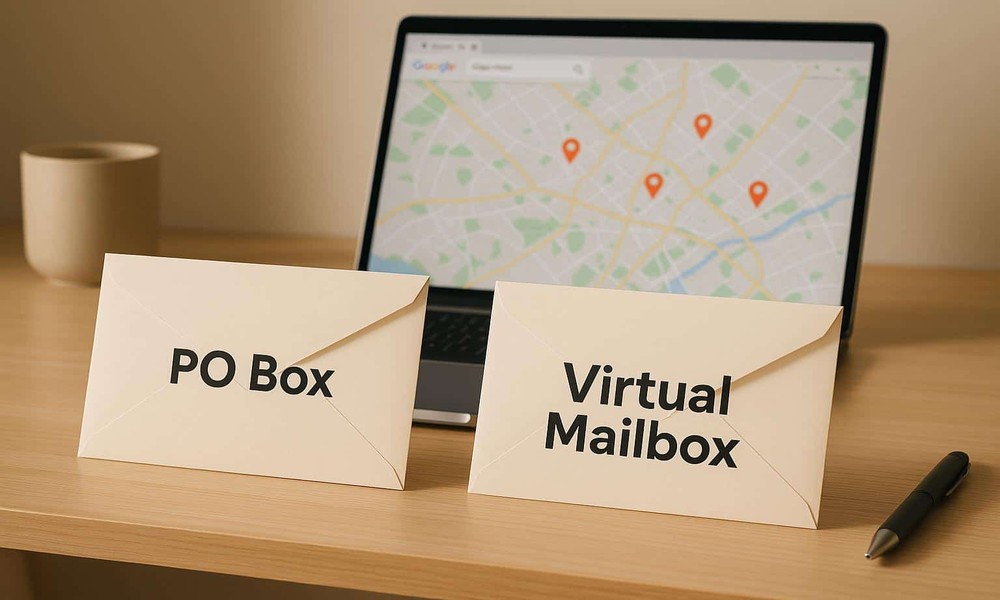

The address question shows up in the same week for most new small business owners. The LLC paperwork asks for a principal office address. The bank wants a physical address for the business account. Stripe wants something to put on customer receipts. Amazon Seller Central wants something to put on return labels. Suddenly the casual choice between a P.O. box, a home address, and a virtual mailbox has consequences that ripple across half a dozen filings, and Newport Beach Mailboxes & More fields a version of this question almost every day.
The right answer depends on what the address actually has to do, not on which option costs the least. The differences between the three are larger than they look on the surface.
What Each Option Can Actually Do
The shorthand that most owners arrive with is roughly correct, but it leaves out the specifics that matter when filings get rejected.
A P.O. box is a USPS-only service. It receives mail from the post office, and that is the end of the list. UPS, FedEx, DHL, and most third-party carriers will not deliver to a P.O. box address. Amazon will not deliver most packages there. Some forms accept a P.O. box and many do not. The California Secretary of State will not accept a P.O. box as the principal office address for an LLC or corporation, and most banks will not open a business account against one.
A home address accepts everything any other physical address accepts. The cost is privacy and professionalism. California’s Statement of Information for LLCs and corporations is public record, which means the address listed there is searchable on the Secretary of State’s website. So is the address listed on most state and local business license filings. Once a home address lands in those records, it becomes effectively unrecoverable as a private piece of information. Coastal Orange County mail theft also remains a real and growing problem, and a home mailbox becomes a more attractive target the moment business mail starts arriving in it.
A virtual mailbox at a Commercial Mail Receiving Agency, or CMRA, is a real street address that accepts all carriers. The CMRA receives the mail on the customer’s behalf under USPS Form 1583, a notarized authorization that has to be on file before any third party can lawfully receive mail addressed to someone else. Most virtual mailbox services include some combination of physical pickup, package handling, mail forwarding, and email notification or scanning. The address looks like any other Newport Beach business address, because it is one.
The Filing and Banking Realities
A few rules separate what owners think they can do from what they will actually be allowed to do:
- California LLC and corporation filings require a physical street address for the principal office. A virtual mailbox at a CMRA satisfies this requirement. A P.O. box does not.
- The registered agent address listed on California filings is a separate field with separate rules. The registered agent must be a person or company with a California physical address where service of process can be made during business hours. A virtual mailbox is generally not appropriate for the registered agent address itself, although a separate registered agent service can be paired with the virtual mailbox for the principal office.
- Business bank accounts at most major institutions, including Bank of America, Chase, and Wells Fargo, accept a CMRA street address. Some online-only banks have stricter verification and may request additional documentation when the address resolves to a CMRA.
- Stripe, PayPal, Square, and most payment processors accept a CMRA address. Amazon Seller Central accepts a CMRA address for the business address field, which is what gets printed on return labels.
- The IRS accepts a CMRA address on Form SS-4 when applying for an EIN.
The form rejections owners run into almost always involve the P.O. box, not the virtual mailbox. The home address generally works on filings but creates the privacy exposure described above, which is harder to fix once it is in the public record.
Which Option Fits Which Business
The decision usually maps cleanly to the type of operation:
- A pure side hustle with low mail volume and no plans to form an LLC may be fine with a home address, at least until privacy or theft risk catches up.
- A registered LLC or corporation, especially one with a public website or a customer-facing business, almost always benefits from a virtual mailbox. The street address holds up across filings, banking, payment processors, and marketing materials, and the home address stays out of public records.
- A traveling consultant, digital nomad, or seasonal Newport Beach resident who needs reliable mail handling year-round leans toward the virtual mailbox for the forwarding and scanning options. USPS Forwarding caps at twelve months and does not handle non-USPS carriers, which leaves Amazon and most commercial deliveries unaddressed.
- A business with very low mail volume, no LLC, and no need to receive packages from Amazon or third-party carriers may find a P.O. box is enough. That category is smaller than most owners assume.
A practical test is to write down every place the business address will actually appear over the next twelve months. Bank account, LLC filing, business license, website footer, invoice template, payment processor, shipping labels, marketing materials, vendor accounts. If any of those require a real street address or all-carrier delivery, the P.O. box is off the table. If any of those will be public, the home address creates exposure that is hard to unwind later.
Talking to Newport Beach Mailboxes & More About the Right Setup
The address decision is one of the few small business choices that is genuinely hard to reverse, because changing it later means updating every filing, every bank, every customer-facing document, and every vendor account. Newport Beach Mailboxes & More offers physical and virtual mailbox rentals with real Newport Beach street addresses, all-carrier delivery from USPS, UPS, FedEx, and DHL, mail forwarding, scanning, and notarization for the USPS Form 1583 under one roof. Stop in or call before the LLC paperwork goes out, not after. Picking the right address the first time is significantly easier than fixing the wrong one.
